The Basics
What is Thatch?
 |
| Thatched Roof Close Up |
The most durable thatching material is water reed (Phragmites Australis) which can last up to 60 years.
The Shannon River and its tributaries used to produce an abundance of water reed. It still does, but increased run off of farm fertilizers in the last two decades have all but ruined this traditional source of reed. When bathed in nitrates, water reeds grow longer and faster. They become much more brittle and are easily snapped. Their useful lifespan on a roof is also shortened tremendously.
Thatch can be dressed into unusual shapes, indeed. In this picture, the thatch flows around the roof line of an old traditional cottage, lifting for a window, then sweeping down to cover the rounded corners.
Today
3 different materials are widely used:
- Long straw
- Combed wheat reed
- Water reed
The type of
reed used will determine the style of finish. Your thatcher will
advise accordingly. In essence, Long Straw retains a `shaggy` look
whilst Combed reed is widely used in the south and west of England.
Water reed, traditionally costs more but is regarded as a superior
product.

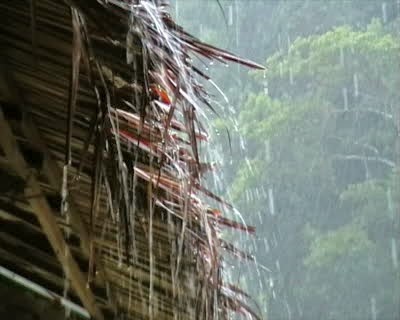
Water reed is naturally waterproof. This is no waterlogged plant, soggy and bloated with water. In fact, the inside of a natural water reed is hollow. The water is kept out by the tight overlapping of cells on the plant's outer layers. If you bundle enough of these water shedding plants together, water simply cannot penetrate. Moisture typically does not absorb into the thatch bundles more than 1 or 2 inches.The thatchers' art consists of carefully laying 5 to 6 foot bundles of reeds atop one another so that an impenetrable shell of waterproofing covers a roof. Each thatch layer is built up to a thickness of around 12 inches and gravity carries rain, sleet, and snow down and off the roof.
One of the great attractions of thatch is that is extremely thermally efficient – warm in winter and cool in summer. Unlike conventional roofing systems that trap heat and moisture vapour in attics, thatched roofs require no attic ventilation.

A water reed thatched roof, 12 inches thick at a pitch angle of 45 degrees meets the most modern insulation standards. The scientific term for insulating properties is "thermal conductance," known as the U value. The U-value of a properly thatched roof is 0.35, which is equivalent to 4 inches of fibreglass insulation between the joists. Only in the last decade have building codes begun to demand this level of roof insulation. Yet, thatch has been providing such a "modern" value for hundreds of years.
An added benefit is that thatch is a much more effective sound insulation than fiberglass. An inch of thatch will stop a microphone from picking up sounds.
How does thatched keep out the rain?
What about ventilation and insulation?
One of the great attractions of thatch is that is extremely thermally efficient – warm in winter and cool in summer. Unlike conventional roofing systems that trap heat and moisture vapour in attics, thatched roofs require no attic ventilation.
A water reed thatched roof, 12 inches thick at a pitch angle of 45 degrees meets the most modern insulation standards. The scientific term for insulating properties is "thermal conductance," known as the U value. The U-value of a properly thatched roof is 0.35, which is equivalent to 4 inches of fibreglass insulation between the joists. Only in the last decade have building codes begun to demand this level of roof insulation. Yet, thatch has been providing such a "modern" value for hundreds of years.
An added benefit is that thatch is a much more effective sound insulation than fiberglass. An inch of thatch will stop a microphone from picking up sounds.
Will thatch stand up to strong winds?
It maybe just reeds but they actually cope quite well! Modern thatching methods make thatch one of the strongest types of roofs, certainly one better able to handle high winds than common asphalt strip shingles. Note that the roof timber work and laths seen in this photo were constructed by The Thatch Company.
Before the thatch is placed on the roof, long brass screws are firmly inserted deep into the wooden roof laths. Twisted onto the screw is a long, heavy duty steel wire. Bundles of reeds are then placed onto the roof. Over the bound reed bundles steel rods are placed. Then the wire which is secured to the lathing is tied through the reeds to the steel rods. The result is a natural water-repelling material firmly bound by steel rods and wires to the roof laths and joists.
Of course, you won't see the steel rods or wires since these are buried 5 to 6 inches below the top reed layer. The result is a light yet extremely durable, steel tied roof. It's not going anywhere! This picture is a hotel in Kinvarra, County Galway. You are looking at the largest thatched roof in Ireland. During the 100 + mile per hour winds of the 1998 St. Stephen's Day storm, not a reed was out of place. This despite the serious damage done to many slate roofs in the area.It should be noted that when rethatching and conserving older buildings, The Thatch Company does not use steel, but the more traditional (and quite effective) wood spar system. Check out our rethatching page for more details.
Benefits of Thatched Roofs
.jpg)
- A properly, professionally installed thatched roof which is maintained on a regular basis and sited away from any overhanging trees will offer great durability. You can expect thatch to last anywhere between 15 to 20 years in good condition.
- Being a naturally insulating material, thatch is able to insulate your home without the need for additional insulating materials in the loft space such as natural or synthetic wools. A good insulator will not only keep your home warm in the winter months but will also keep it cool during the summer.
- Thatch changes with age, and as it settles in it will begin to darken. This helps it to blend with the surrounding countryside, creating a sense of harmony and belonging which more boldly coloured and textures tiles and slates cannot offer. This makes thatched roofs perfectly suited to more rural locations, although it is just as attractive in towns and villages.
- Thatch is highly environmentally friendly, and is one of the best eco roof types around. The materials needed are grown easily and harvested with little to no machinery. Whilst thatched roofs are more labour intensive to source and construct than some other options, most of the materials are sourced from rural communities which benefit greatly from the work created.
- One of the most interesting characteristics of thatch is its ability to be shaped into natural, flowing forms unlike the harsh lines that tiles create. This adds great character and personality to a house, and allows you a lot of freedom when designing the shape of the roof.
- Thatching your roof is a fairly low cost method of adding on space to your home by utilising roof space which would otherwise form a loft. Additionally, the high, open ceilings create a very spacious feel to the rooms.
The Cons
- Due to the very heavy labour intensiveness of installing thatched roofs, they are generally a little more expensive than alternative roofing materials might be.
- When it comes to insuring your home, you must expect to pay a premium due to the higher cost of the material and its tendency to dry out and become highly flammable if not properly maintained.
- You will have to carry out an annual inspection of thatched roofs to make sure that any necessary minor repair work is carried out as soon as possible, as this will prevent you having to undertake much more expensive repairs further down the line. The ridge cap – which is the part of the roof that is most abused by the elements – will need to be seen to a little more often in order to prevent any leaks from opening up and to maintain the structural integrity of the roof in general.
- It is important to make sure that thatched roofs are located away from any overhanging trees. This will stop the material from drying out too quickly, which can be hazardous. Also, if thatch is left too damp for too long then it will become susceptible to rot and fungal growths.
- Thatched roofs must be regularly treated with fire-retardant, especially during the summer when the weather can cause thatch to become easily ignitable. The treatment of thatch is based on the impregnation of the material with a combination of biological preservative and fire retardant. The risk of fire cannot be forgotten, and many professional thatchers recommend that a fire board is used for added safety.
Buying a Thatched Property
All too often prospective owners of thatched houses are persuaded by family and friends that owning a thatched property is expensive and requires constant attention. This is not the case.
Thatching Advisory Services are able to offer a range of services that will indicate, before you exchange contracts, the immediate costs, future planning and of course the benefits of owning a property that is part of our National Heritage.
SURVEY OF THE THATCH ONLY - Carried out by thatch surveyors employed by Thatching Advisory Services which will confirm exactly in writing the condition of the thatch, what precautions can be taken to extend the life expectancy of the roof and indicate the current price of the works to be undertaken.
Will a thatched building hold its value?
Yes! Homes with thatched roofs command higher selling prices than similar ones with tile or slate.Thatch is also very effective in commercial settings such as restaurants, hotels, pubs, and retail shops. If you're trying to tempt motorists into your commercial establishment, thatch beckons more convincingly than neon.'How much is it going to cost me?'
Insurance
There is no problem getting insurance on your thatched building. The Thatch Company has been certified by one the world's largest insurance companies and they are willing to provide cover for buildings which we thatch and fireproof. The cost to you is generally the same as that required for a similar building with a conventional roof.
Thats about as much as I know on the subject matter,
Until the next time, I bid you adieu my dear Sirs and Madams!


