Showing posts with label Bathroom. Show all posts

Tuesday, 10 June 2014

Accessorise, Accessorise, Accessorise

Accessorising the bathroom is one of the most affordable ways to place a personal stamp upon this room where the big items come with a big price tag and an equally big renovation headache. If you take the time to shop with care and have an attitude toward letting your personality take shape inside this most utilitarian of rooms in your house, you can transform it almost into a centrepiece.


Toilet Seats

The first thing to get down is the toilet seat. Toilet seats are not what they used to be because they have become a bona fide bathroom accessory. Today’s toilet seats and toilet seat covers are made in a variety of styles that have transformed them from the merely useful to the truly decorative. You can get toilet seats made in the shape of guitars or pianos as well as those are tabbed so that each person who uses the toilet has their own private seat. Toilet seat covers also are available in an array of styles.
Photo Credit: maxually


Sink Accessories

Photo Credit: April Killingsworth
Accessorising a bathroom really takes on the personality of its owner when you focus on the toiletry props that will adorn the top of the sink. Go into any just about any shop that sells items for the home and you can find toothbrush holders, soap, Cats, (kidding) dishes and tissue dispensers that match. More importantly, you can find bathroom accessories that reflect your taste in colour or pop culture.

Mirrors

Mirrors are essential accessories for the bathroom. You use them for shaving, applying makeup and getting an idea of just how effectively your diet is coming along. Mirrors can also be utilized to give the illusion that a cramped bathroom is much bigger.

Linens

Towels and washrags are useful inside the bathroom, but they should also be considered aesthetic accessories. A bathroom just looks cleaner and more attractive when time is taken to carefully accessorise, using matching towels hanging from the shower or on the wall. The colours should ideally match the overall design of the décor.

Shower Curtains
Photo Credit: Judy van der Velden

Shower curtains have also become an important accessory in the bathroom. If a see-through vinyl curtain is not what you want, you can buy a shower curtain that replays in silhouette the famous shower scene from the movie “Psycho.” Curtain décor ranges from pop culture like this to animal prints to geometric designs.

Tap Fixtures

Tap fixtures are a good way to accessorise a bathroom by lending it a sense of style. If your taps are currently mounted to the rim of the sink, consider renovating to allow you to create a greater sense of elegance by installing wall-mounted taps. If you don’t like your current chrome taps, accessorise to match your desires by replacing with gold, red or black taps.

Plants

Plants that thrive in humid conditions not only can be used as accessories in the bathroom, but provide much-needed oxygen when you step breathlessly out of a hot shower. Plants can infuse the sterile conditions of the typical bathroom with a sense of life as well. 
Photo Credit: el_finco
I bid you adieu my dear Sirs and Madams!

Thursday, 10 April 2014

How to design a Bathroom

Very few rooms affect a home's value like a bathroom. Whether you are building a new home or are ready to remodel an existing bathroom, use this guide to design the best bathroom.


Here is an overview of the basic guidelines for four of the most important elements of bathroom design.

Space Planning

Perhaps the most difficult part of designing a bathroom is deciding where everything should go. In a new bathroom, it's easy to be overwhelmed by a blank slate. In a remodel, you may be limited by space constraints and existing plumbing placement (relocating plumbing is very expensive and not a cost-effective plan for most bathroom upgrades). To start the design process, take exact measurements of the floor plan and first place the essential elements, using these basic guidelines:
• Door: Measured jamb to jamb, the entry door should be 34-inches wide, but no smaller than 24-inches wide. In a small bathroom, hang the door so it swings out, rather than in, to avoid interference with other doors, cabinets, and fixtures.
• Shower: For comfort and safety, the shower should be at least 30x30x80 inches at the shower-head  but most modern bathroom designs allow for 90-inch-high ceilings with showers of at least 36-inches square. The shower surround should extend at least 3 inches above the shower-head  Hinged shower doors must open outward to prevent someone from becoming trapped after losing consciousness.
• Sink: The centreline of the sink must be 15 inches from the side-wall or tall obstacle (at least 20 inches is preferable). For double sinks, the distance between their centrelines should be 30-36 inches. Allow at least 4 inches between the edge of the sink and the wall.
• Toilet: The centreline of the toilet or bidet must be 15 inches, and preferably at least 18 inches, away from the wall or other obstacles. If you plan to place the toilet in its own closet, the compartment must be 30x60 inches (36x66 inches is more comfortable) and should include a swing-out or pocket door.
• Floor space: Allow a mandatory 21 inches of open space in front of the toilet, sink, and tub, and 24 inches in front of the shower entry. If possible, keep at least 30 inches free in all areas so people with limited mobility can use the facilities comfortably.

 
Electrical and Ventilation

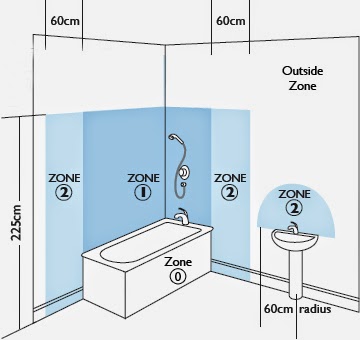
Make sure your bathroom is bright enough for grooming and showering by installing plenty of general and task lighting. Have fun choosing fixtures for the space but remember you must include at least one wall-switch controlled light with the switch placed by the entrance. Also, any hanging fixtures cannot be closer than 3 feet horizontally and 8 feet vertically from the top of the bathtub rim. If you add lights within the tub or shower, they must be labelled as "suitable for damp/wet locations." Use only ground-fault circuit interrupter (GFCI) receptacles in the bathroom and never install an outlet or switch within the shower or tub space. For ventilation, a small window may meet code requirements, but it's not an efficient solution. Better is to use a mechanical exhaust system that vents to the outside in each enclosed area.


Safety Issues

It may be the smallest room in the house, but the bathroom is big on potential danger. Every year about 235,000 people visit emergency rooms after being injured in the bathroom, according to the Centres for Disease Control and Prevention. Protect your family from harm by using slip-resistant flooring (for ceramic tile, choose a "wet" rating of .5 or higher). Clipped or rounded corners for counter-tops are safer than sharp edges. Shower and tub control valves must be pressure balanced, thermostatic mixing, or a combination of both to reduce scalding risk. It's mandatory to use tempered glass for shower enclosures, partitions, and windows or doors in the shower or whose bottom edge is less than 18 inches above the floor. Finally, although shower and tub grab bars are required only in Americans with Disabilities Act (ADA)-compliant housing or when there are steps leading into a bathtub, it's a good idea to add them in every bathroom in case of future mobility issues.

Storage and Accessories

Building codes rarely address bathroom storage or accessories, but they are nonetheless very important design concerns. If possible, create easily accessible storage options for toiletries, linens, and other bath supplies using medicine or vanity cabinets and recessed or hanging shelving. Hang a mirror above the sink at eye level. Place the toilet paper holder 8-12 inches in front of the edge of the toilet bowl and 26 inches above the floor. Add towel bars, robe hooks, soap dishes, and other practical accessories in convenient locations around the bathroom.

I bid you adieu my dear Sirs and Madams!


REMEMBER TO READ OUR MOST RECENT BLOG POSTS CLICK HERE